If you’ve ever felt like your skin reacts to everything, you’re not alone. Sensitive skin can feel like a constant battle, redness after trying a new moisturizer, stinging from what’s supposed to be a “gentle” cleanser, or breakouts from products that work for everyone else. The truth is, your skin isn’t being difficult. It’s trying to tell you something important.
Living with sensitive skin means navigating a world full of harsh chemicals, synthetic fragrances, and irritating ingredients that seem to hide in every product. But here’s the good news: building a non toxic skincare routine doesn’t have to be complicated or overwhelming. With the right approach and natural skincare products, you can finally achieve that healthy, balanced glow without the irritation.
Why Your Skin Reacts to Every Product
Before we dive into solutions, let’s talk about why this happens. Your skin has a protective barrier made up of lipids, ceramides, and natural oils. When this barrier is compromised whether from harsh ingredients, environmental stressors, or genetics your skin becomes more vulnerable to irritation.
Think of your skin barrier like the walls of a house. When those walls have cracks and gaps, everything from cold air to pests can get in. Similarly, when your skin barrier is damaged, irritants penetrate more easily, triggering inflammation, redness, and that frustrating reactive response.
Several factors can weaken your skin barrier:
Genetic predisposition plays a significant role. Some people are simply born with thinner skin or fewer lipids in their barrier, making them more prone to sensitivity.
Over-exfoliation is incredibly common. We live in a culture obsessed with glowing skin, which has led many people to use acids, retinoids, and scrubs too frequently. This strips away the protective layer your skin desperately needs.
Environmental aggressors like pollution, UV radiation, extreme temperatures, and dry air constantly assault your skin, breaking down its defenses over time.
Using the wrong products is perhaps the most fixable issue. Many mainstream skincare products contain ingredients that were never meant to sit on human skin for extended periods.
Ingredients to Avoid for Sensitive Skin
Understanding what to avoid is just as important as knowing what to use. Here are the major culprits behind sensitive skin reactions. Natural Skincare Routine for Sensitive Skin should not have these.
Synthetic Fragrances
This is the number one sensitizer in skincare products. When you see “fragrance” or “parfum” on an ingredient list, it can represent a combination of over 3,000 different chemicals—and companies aren’t required to disclose which ones they use. These fragrances are designed to smell appealing, not to be gentle on skin.
Why they cause reactions: Fragrance molecules can penetrate the skin barrier and trigger an immune response, leading to contact dermatitis, redness, and irritation. Even if you don’t react the first time, repeated exposure can cause sensitization over time.
Sulfates (SLS and SLES)
Sodium Lauryl Sulfate and Sodium Laureth Sulfate are aggressive cleansing agents found in everything from face wash to shampoo. They create that satisfying lather we’ve come to associate with “clean,” but at a significant cost.
Why they cause reactions: Sulfates strip away your skin’s natural oils far too effectively, disrupting the lipid barrier and leaving skin vulnerable, dry, and irritated. For sensitive skin, this creates a vicious cycle of damage and inflammation.
Alcohol (Denatured Alcohol, SD Alcohol)
Not all alcohols are created equal. Fatty alcohols like cetyl and stearyl alcohol are actually beneficial and moisturizing. However, denatured alcohol and SD alcohol are another story entirely.
Why they cause reactions: These drying alcohols evaporate quickly from the skin, taking moisture with them. They can cause immediate tightness, long-term dehydration, and a compromised skin barrier. Many toners and acne products are loaded with these.
Parabens
Methylparaben, propylparaben, and butylparaben are preservatives used to extend shelf life. While the jury is still out on some of their health effects, sensitive skin definitely doesn’t appreciate them.
Why they cause reactions: Parabens can cause allergic reactions and contact dermatitis in susceptible individuals. They also have mild estrogenic activity, which some research suggests could disrupt skin function.
Essential Oils (Even Natural Ones)
This one surprises people. Essential oils are natural, so they must be gentle, right? Unfortunately, no. Oils like lavender, tea tree, peppermint, and eucalyptus are highly concentrated plant extracts.
Why they cause reactions: Essential oils contain volatile compounds that can irritate and sensitize skin. Just because something is natural doesn’t mean it’s appropriate for sensitive skin. Many people with conditions like rosacea or eczema find essential oils particularly triggering.
Chemical Sunscreen Filters
Ingredients like oxybenzone, avobenzone, and octinoxate work by absorbing UV rays and converting them to heat.
Why they cause reactions: The heat conversion process and the chemicals themselves can trigger inflammation in sensitive skin. Physical/mineral sunscreens with zinc oxide or titanium dioxide are typically better tolerated.
Synthetic Dyes and Colors
Those pretty pink toners and blue eye creams? They get their color from synthetic dyes that serve zero skincare purpose.
Why they cause reactions: These are pure additives with no benefit to your skin, but plenty of potential to cause allergic reactions and irritation.

Your Chemical Free Skincare Routine
Now that you know what to avoid, let’s talk about what to embrace. A truly effective routine for sensitive skin focuses on gentle, minimal, and nourishing products.
Step 1: Gentle Cleansing (Morning and Night)
Start with a cream or oil-based cleanser that doesn’t foam excessively. Look for ingredients like:
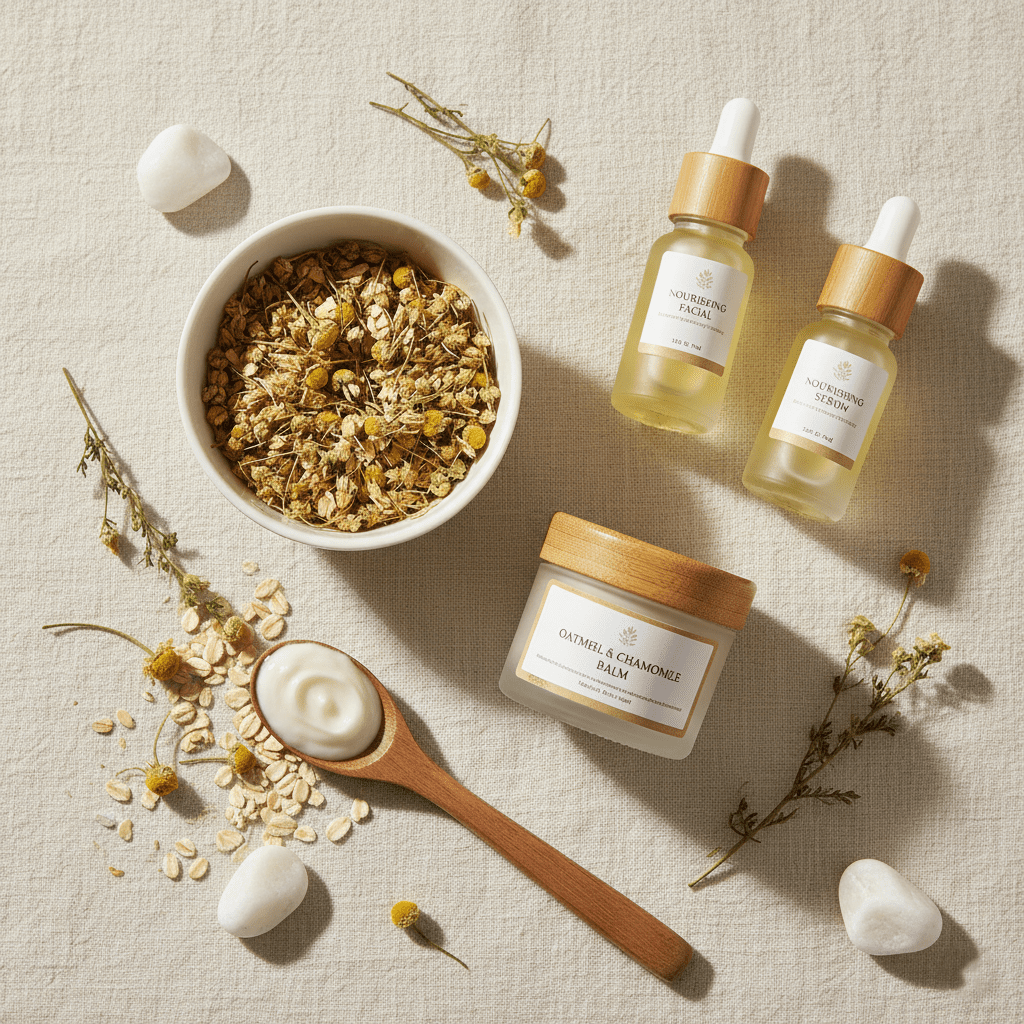
- Oat extract: Naturally soothing and anti-inflammatory
- Chamomile: Calms redness and irritation
- Jojoba oil: Mimics skin’s natural sebum
- Glycerin: A humectant that draws moisture to skin
Your morning cleanse can even be just lukewarm water if your skin tolerates that better. There’s no rule that says you must use a cleanser twice daily.
Step 2: Hydrating Toner (Optional but Beneficial)
If you use a toner, make it a hydrating one—not an astringent. Look for simple formulas with:
- Rose water (if you tolerate it—some sensitive skin types don’t)
- Aloe vera juice: Soothing and hydrating
- Hyaluronic acid: Holds up to 1,000 times its weight in water
Apply to damp skin and move quickly to the next step to seal in moisture.
Step 3: Serum
This is where you can address specific issues like aging, hyperpigmentation, or extra hydration.
For anti-aging: Look for the best vitamin C serum formulated for sensitive skin. Not all vitamin C is created equal. L-ascorbic acid, while effective, can be quite irritating. Instead, seek out gentler derivatives like:
- Magnesium ascorbyl phosphate: Stable, gentle, and effective
- Sodium ascorbyl phosphate: Less likely to cause irritation
- Tetrahexyldecyl ascorbate: A lipid-soluble form that penetrates well without irritation
When choosing the best vitamin C serum, look for a concentration between 5-10% rather than the aggressive 20% formulas. Your sensitive skin will thank you, and you’ll still see brightening and collagen-boosting benefits.
For hydration: Hyaluronic acid serums are generally well-tolerated. Apply to damp skin for maximum benefit.
For barrier repair: Look for ceramide-based serums or niacinamide (vitamin B3) at concentrations of 2-5%.
Step 4: Moisturizer (Morning and Night)
Your moisturizer should be fragrance-free, rich in skin-identical ingredients, and free from common irritants. Excellent ingredients include:
- Ceramides: Rebuild and maintain the skin barrier
- Squalane: A lightweight oil that mimics skin’s natural sebum
- Shea butter: Rich and nourishing without being heavy
- Colloidal oatmeal: Clinically proven to soothe irritated skin
- Centella asiatica: A botanical with proven wound-healing properties
For nighttime, you can use a slightly richer formula to support your skin’s natural repair process.
Step 5: Sun Protection (Morning Only)
This is non-negotiable. UV damage is one of the leading causes of premature aging and can exacerbate sensitivity.
Choose a mineral sunscreen with zinc oxide or titanium dioxide rather than chemical filters. These create a physical barrier and are far less likely to irritate. Look for:
- Broad spectrum SPF 30 or higher
- Added antioxidants like vitamin E
- A formula designed for sensitive skin
- Tinted versions if you find the white cast bothersome

Natural Skincare Ingredients That Actually Work
The natural skincare movement isn’t just a trend—it’s rooted in the fact that our skin often responds better to ingredients it recognizes and can metabolize.
Calendula: This golden flower has been used for centuries to heal wounds and soothe inflammation. It’s gentle enough for the most reactive skin.
Sea buckthorn oil: Rich in omega-7 fatty acids, this oil is deeply nourishing and helps repair damaged skin barriers.
Bisabolol: Derived from chamomile, this ingredient is a powerhouse anti-inflammatory that reduces redness and sensitivity.
Beta-glucan: Sourced from oats or mushrooms, this ingredient boosts skin’s immune response and strengthens the barrier.
Allantoin: Found in comfrey root, this promotes healing and skin cell regeneration without irritation.
Green tea extract: Packed with antioxidants that protect against environmental damage and soothe inflammation.
The Anti Aging Skincare Routine for Sensitive Skin: Common Questions Answered
“Can I use retinol if I have sensitive skin?”
The short answer: maybe, but proceed with extreme caution. Traditional retinol is often too harsh for sensitive skin, causing peeling, redness, and increased reactivity. However, there are alternatives:
- Bakuchiol: A natural retinol alternative that provides similar anti-aging benefits without the irritation
- Retinyl palmitate: A gentler retinoid derivative
- Peptides: These signal your skin to produce more collagen without the harsh exfoliation
If you do want to try retinol, start with the lowest concentration (0.025%), use it only once or twice a week, and always buffer it with moisturizer.
“How often should I exfoliate?”
Most people with sensitive skin should exfoliate no more than once per week, if at all. When you do exfoliate, skip the physical scrubs entirely—they create micro-tears in already vulnerable skin.
Instead, use a gentle enzyme exfoliant made from pumpkin, papaya, or pineapple. These work by dissolving dead skin cells without scrubbing. Use for 3-5 minutes and rinse thoroughly.
“Will natural products really make a difference in aging?”
Absolutely. While you might not see the dramatic peeling that comes with harsh anti-aging products, natural ingredients work with your skin rather than against it. Over time, a consistent routine with antioxidants, gentle actives, and barrier-supporting ingredients will show results:
- Reduced fine lines through collagen support
- More even tone from gentle brightening ingredients
- Better texture as your barrier strengthens and retains moisture
- Less overall reactivity as chronic inflammation decreases
The key is patience. Natural skincare is a marathon, not a sprint.
“How long until I see results?”
Your skin’s cell turnover cycle is approximately 28 days, though this slows as we age (up to 40-60 days for those over 50). Give any new routine at least 6-8 weeks before judging effectiveness. You should notice less irritation within 1-2 weeks, but visible improvements in texture, tone, and fine lines take longer.
“Can sensitive skin use acids like glycolic or lactic acid?”
It depends on the individual, but most sensitive skin types do better with:
- Lactic acid: Larger molecule size means less penetration and irritation
- Polyhydroxy acids (PHAs): Like gluconolactone—these are the gentlest chemical exfoliants
- Azelaic acid: While technically not an AHA, it’s gentle and addresses multiple concerns
Skip glycolic acid and salicylic acid—they’re too penetrating and drying for most sensitive skin.
“Is organic the same as non toxic?”
Not necessarily. Organic means the ingredients were grown without synthetic pesticides or fertilizers, which is great. However, organic products can still contain essential oils, harsh botanical extracts, or other irritants. Always check the ingredient list rather than relying solely on “organic” or “natural” labels.

Common Mistakes That Make Sensitive Skin Worse
Over-layering products: More is not better. A simple routine with 4-5 well-chosen products is far superior to a 10-step regimen that overwhelms your skin.
Hot water: This strips your skin barrier. Use lukewarm water for cleansing and avoid long, hot showers.
Constantly switching products: Your skin needs consistency to heal. Give products at least 4-6 weeks unless you have an obvious adverse reaction.
Using “natural” DIY treatments: Lemon juice, baking soda, and undiluted apple cider vinegar are far too harsh for sensitive skin, despite what the internet says. Stick to formulated products with balanced pH.Forgetting about gut health: Your skin is your largest organ, and it reflects internal health. Food sensitivities, inflammation, and gut dysbiosis can all manifest as skin sensitivity. Consider an anti-inflammatory diet rich in omega-3s, antioxidants, and probiotics.
Finding Your Best Sensitive Skin Products
When shopping for your non toxic skincare routine, look for brands that:
- List all ingredients transparently
- Formulate without the top allergens and irritants
- pH-balance their products (ideally 4.5-6.5 for cleansers and toners)
- Conduct patch testing and hypoallergenic testing
- Offer fragrance-free options
- Use minimal, recognizable ingredients
Some people prefer to start with certified organic or EWG-verified products for extra assurance, though these certifications aren’t mandatory for a product to be gentle and effective.
Creating a chemical free skincare routine for sensitive skin isn’t about following trends or buying the most expensive products. It’s about understanding your skin’s unique needs and respecting its limitations.

Your skin barrier is repairable. With consistent use of gentle, nourishing products free from common irritants, you can reduce reactivity, strengthen your skin’s defenses, and yes—address signs of aging naturally and effectively.
Start simple. Introduce one product at a time. Patch test on your inner arm or behind your ear before applying to your face. Keep a skincare journal noting what works and what doesn’t. Over time, you’ll develop an intuitive understanding of your skin that no dermatologist or beauty influencer can provide.
Remember, the goal isn’t perfection—it’s healthy, comfortable skin that you feel good in. That radiant, calm complexion you’ve been searching for? It’s absolutely achievable with the right natural skincare approach.
Be patient with your skin. Be kind to it. And most importantly, be consistent. Your skin has an incredible capacity to heal when you give it the right tools and remove the obstacles standing in its way.