Discover how to create the perfect facial skincare routine for your complexion and how to combine your products for maximum effectiveness.
The cosmetics industry is booming, making it difficult to choose between essential and unnecessary products. In what order should you apply your creams and serums? What should you look for before purchasing new facial skincare products? What are the important ingredients, and how can you identify the products best suited to your skin? With this guide, create your own facial skincare routine for a radiant complexion.
Yes, it’s true, some evenings, fatigue takes over and other mornings, you don’t have time to spend five more minutes taking care of your skin. However, your facial skincare routine is essential, because your skin is put through its paces throughout the day. Therefore, it’s essential to protect it from pollution and UV rays. Your skin also needs to be hydrated, rid of dead skin cells and given a little boost to reduce the signs of aging. So, how can you maintain luminous and healthy skin? Simply by creating your own facial skincare routine. But be careful, it must be simple, effective and adaptable as desired.
Determine your skin type
Our genetic makeup determines our skin type. But certain factors such as stress, lifestyle, and hormonal changes can alter it. “There are four main skin types: normal, dry, oily, and combination,” Then, each skin type has secondary characteristics: sensitive, dehydrated, mature, acne-prone, prone to redness, or sunburn.
Normal skin has small pores and is not prone to redness, breakouts, or dry or oily areas. If your skin lacks suppleness, is sometimes flaky, or your complexion is dull, you have dry skin. Oily skin is more likely to develop blackheads and blemishes, and its pores are larger and therefore more visible. Finally, combination skin is generally oilier in the T-zone: the forehead, nose, and chin. The cheeks, on the other hand, can be normal or even dry.
The good news is that you don’t need a complex, Korean-inspired 12-step routine to achieve beautiful skin. But it’s still worth taking a strategic approach. Start by determining your skin type, then your skin concerns. This will guide you toward the products you need. And remember: “Your morning routine should prioritize protection, while your nighttime routine should nourish and stimulate the skin.
A Customized Facial Routine
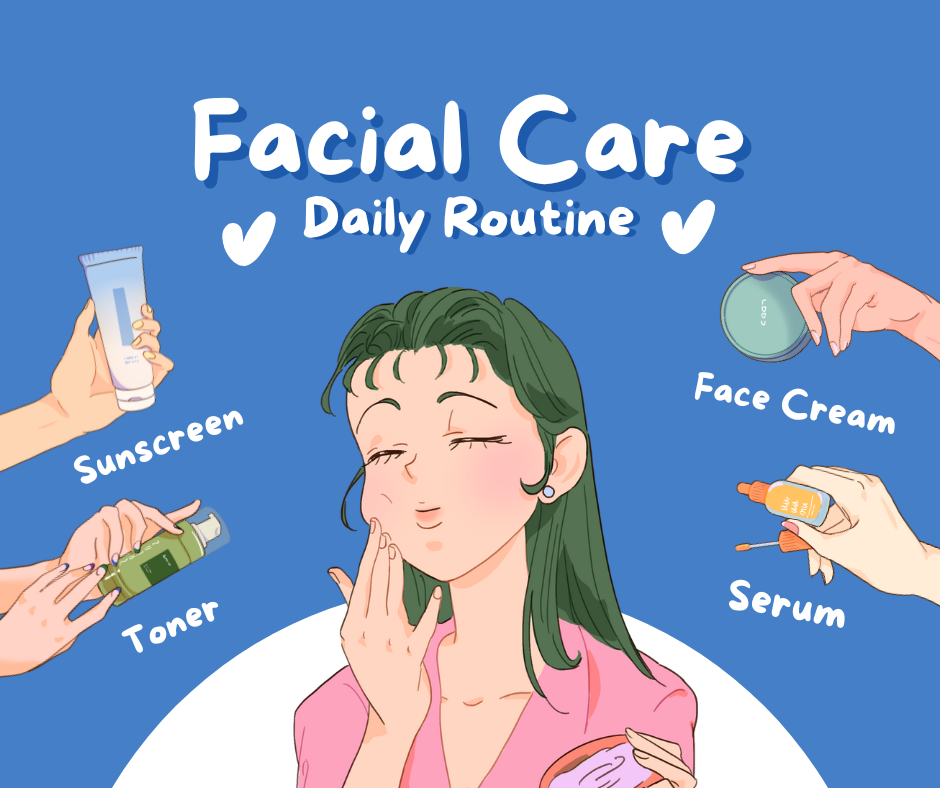
While a basic routine varies slightly depending on your skin type and goals, it generally consists of three steps: cleansing morning and evening; a radiance-boosting treatment, serum, or toner, which can be used morning and/or evening; and a moisturizer. A more in-depth facial routine will take more time but will address the problem in depth and address your specific needs.
Here’s an idea for a basic facial routine:
MORNING AND EVENING
-Cleanser
-Serum
-Moisturizer

Cleansing
Cleansing your skin is one of the most important steps in your facial skincare routine. Your skin is affected daily by pollution and other impurities in the air. It’s therefore essential to cleanse it every night. In the morning, cleanse your skin again to prevent clogged pores. How to do this? It all depends on your skin type and personal preference. Those with dry skin will prefer a milk or oil-based cleanser. Those with oily or combination skin can use cleansing foams or even cleansing oils, as they effectively remove excess serum. In this case, it’s best to double cleanse at night to prevent clogged pores. Rose water, on the other hand, is suitable for all skin types.
Toning Treatment
Toners are applied immediately after cleansing. Light and fluid, they are designed to remove the most stubborn impurities while providing nutrients to balance the complexion and facilitate the absorption of subsequent products. Suitable for all skin types, alcohol-free toners soften and hydrate dry skin while balancing its pH and effectively remove excess sebum from oily and combination skin.
Boosters
As you’ve probably guessed, they’re there to give your skin a boost! Made with specific ingredients, they contain a more concentrated active ingredient that matches your skin’s specific needs and type. They can help rehydrate, plump, and revitalize the skin more deeply. Toners and boosters are lighter than serums and should therefore be applied beforehand. There’s no need to use them every day: you can add them to your routine whenever you feel your skin needs it.
Serums
More fluid than day or night creams, serums are generally more concentrated in active ingredients. Their light texture allows them to be absorbed deep into the skin to act where they really make a difference. Suitable for all skin types, they are generally applied before moisturizer. To know about Best serums, check out 6 Best Vitamin C serum .
Eye Creams
Regardless of the texture of your eye cream, it’s best to apply it before your oil/moisturizer. Apply a small amount to your ring finger and pat this particularly sensitive skin. This area is so delicate that it requires special care: too high concentrations of active ingredients can be damaging. If you have fine lines, puffiness, hyperpigmentation, or dark circles around your eyes, an eye cream will be your best ally.
“If you tend to have puffiness under your eyes, I recommend applying your eye cream in the morning,” warns international skincare expert Maria James. “The skin around the eyes is thinner and circulation slows down during sleep, so products can pool in this delicate area.”
Day and Night Creams
Apply your day cream in the morning and your night cream in the evening. Choose a cream specifically tailored to your needs to hydrate your skin, prevent water loss, and leave it smoother and softer.
SPF
It’s important to protect your skin from UV rays, even in winter. While many creams contain SPF, it’s actually recommended to use sunscreen in addition to your day cream.
Oils
Oils nourish the skin and retain all the active ingredients. Choosing an oil will therefore be a matter of preference. If your skin is particularly dry, you can use an oil in addition to your moisturizer. However, oily or blemish-prone skin can skip the oil altogether. Water-based moisturizers won’t be able to penetrate under the oil. Therefore, it’s a good idea to apply an oil to the driest areas of your face after applying the cream (if you use one). Alternatively, massage your face with a little oil if using it alone.
Masks and Exfoliants
Face masks and exfoliants should be used about twice a week. Exfoliating first will enhance the effects of your mask.
“Doing a mask one night a week is a great way to give your skin a boost of energy. If your skin is more oily, opt for a charcoal mask. If you need hydration and radiance, an AHA mask or a hydrating sheet mask is ideal”. On mask days, you can skip the booster, serum, and maybe even the night cream or oil, depending on your skin type and the mask you’re using. If your mask is very nourishing, you won’t need extra hydration. If you’ve chosen an AHA mask, a moisturizer will complete your at-home pampering experience.
An exfoliant is a gentle facial scrub that works differently from other types of exfoliation. A good exfoliant contains acids that allow dead skin cells to be removed more easily from the inside out, leaving your skin fresher and brighter. With age and sun damage, it becomes harder for your skin to remove dead skin cells. Exfoliation is therefore essential. Since your skin needs to get used to it, start gently. Generally, it’s recommended to exfoliate your face once or twice a week. If you do it regularly, you’ll find it’s a very effective solution for blemishes, wrinkles, and dry skin. Remember to moisturize your skin well after each exfoliation.
How to combine your products?
A good way to remember the order in which to apply your products is to start with the thinner, water-based products, like the toner and booster, and follow with the thicker, oil-based products. In the morning, always finish with a sunscreen.
Adapt your facial skincare routine to your age
As skin ages, it’s important to consider adapting your facial skincare routine, as our hormones and lifestyle can change dramatically between the ages of 20 and 40.
In general, younger skin needs creams and serums with light textures. Products that are too rich or too nourishing can cause breakouts. So don’t rush into anti-aging products!
From the age of 40, hormone secretion, particularly estrogen, decreases, resulting in dry skin. The need for hydration increases, and combining several products is essential. But it’s not just about choosing richer products: you can also select more hydrating active ingredients, such as hyaluronic acid, found in some serums and ampoules. To maintain all the benefits of this hydration, follow with your day or night cream.
As we age, cell turnover also slows down. That’s where exfoliation comes in. It’ll make you look and feel younger. Well-exfoliated skin also reflects light better, making it appear less dry. Exfoliation allows the ingredients in our other skincare products to be absorbed more effectively. When we remove dead skin cells from the surface of the skin, we set the stage for our skincare routine.
It can take a few tries to find a skincare routine that works for you. “If you’re suddenly getting breakouts, you need to reduce the amount of moisturizer,” says Maria “Switch to a gentle cleanser and a charcoal mask twice a week, and exfoliate more regularly