Does your facial skin have a shiny appearance? You guessed it, you have oily skin. Taking care of this skin type is quite easy these days; the key is to adopt the right techniques and products. Discover and adopt our special beauty routine for oily skin!
What is oily skin?
First and foremost, it’s important to briefly review the origin of oily skin: the overproduction of sebum. Sebum is a natural lipid film secreted by the sebaceous glands located in the dermis. Essential to the skin, sebum acts as a protective barrier against dryness, pollution, certain microbes, and more. By lubricating the skin, sebum makes it “waterproof” and maintains its hydration.
However, sometimes the sebaceous glands produce more sebum than necessary. This overproduction is called seborrhea. Hormonal factors, the environment, diet—several causes can lead to excessive sebum production.
Step 1 – Gently cleanse your skin
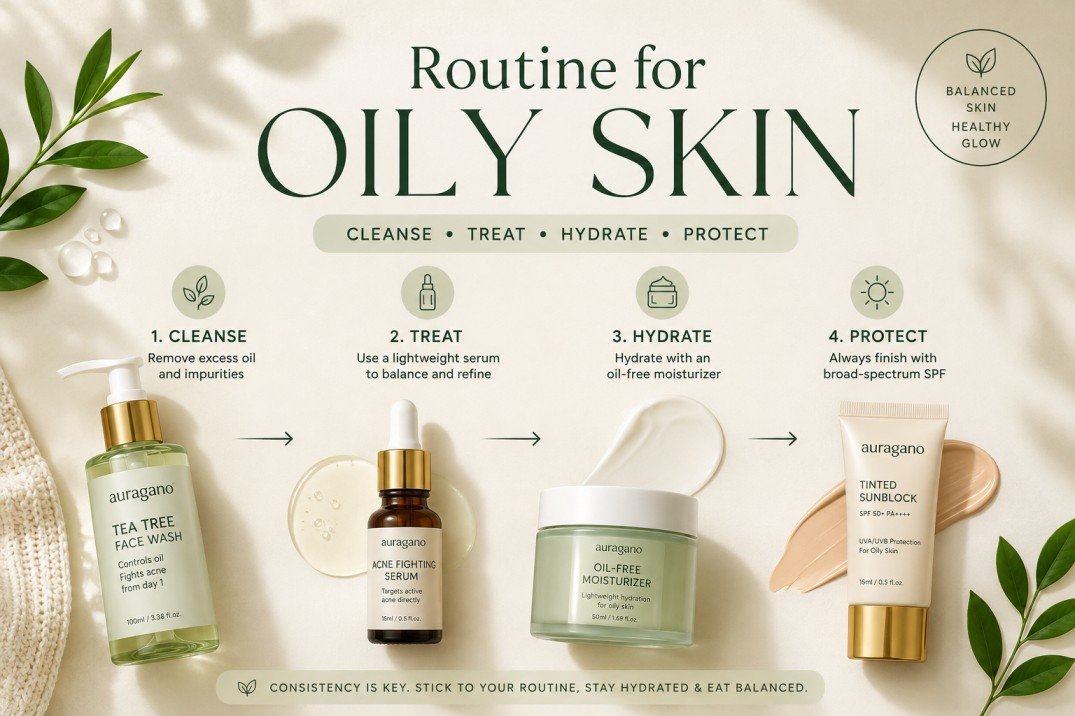
The first beauty step to adopt for oily skin, as with all skin types, is cleansing. But be careful: it must remain gentle, without irritating the skin. The goal is to remove impurities and excess sebum, while respecting the skin’s natural balance. Overly aggressive cleansing can weaken the skin and promote the appearance of blemishes.
To gently cleanse your skin, opt for formulas based on naturally derived ingredients with purifying and soothing properties, as well as comfortable textures such as foams, oils, or gels.
Step 2 – Complete cleansing with a toner
To complete cleansing, use a toner to remove any remaining residue and prepare the skin for subsequent skincare products. Soak a cotton pad with an organic purifying lotion, then apply it to your entire face (avoiding the eye area). Your skin will feel fresh, clean, and visibly more balanced, and your skin texture will appear refined.
Step 3 – Target imperfections with a serum
Serum is a key element of any beauty routine. More concentrated in active ingredients, it addresses specific concerns (dehydration, imperfections, radiance, etc.).
For blemish-prone skin, Serum helps visibly reduce the appearance of 5 types of imperfections (blackheads, pimples, enlarged pores, redness, and residual marks). Its formula, combining lactic acid and salicylic acid, helps improve the appearance of skin texture and visibly smooth the skin.
Step 4 – Hydrate without weighing down the skin
Even oily skin needs hydration. It is therefore essential to use a suitable cream that hydrates, nourishes, and mattifies without leaving a greasy residue.
Opt for light, fluid textures that are quickly absorbed. Moisturizing Cream hydrates the skin, helps mattify, and improves its appearance, thanks to its formula enriched with organic peppermint and naturally derived essential oils. Steps 1 through 4 can be performed daily, morning and evening.
Step 5 – Exfoliate and use a mask
This step should be done once or twice a week, depending on your skin’s needs. Facial exfoliation helps remove dead skin cells and refine skin texture for a brighter complexion. Choose a gentle exfoliant, such as a grain-free one containing salicylic acid, to help visibly smooth the skin.
Complete with a face mask suitable for oily skin, with purifying and soothing properties, to improve the appearance and texture of the skin.
Don’t forget to moisturize your skin after each application.
Get this Quiz to know your skin types and make routine for oily skin according to your need and budget.